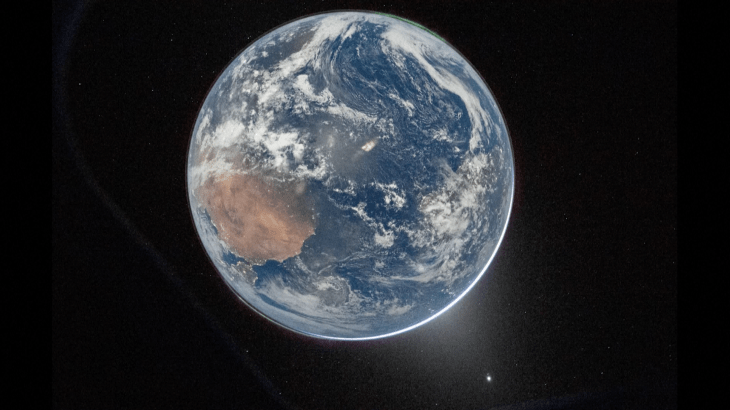
As Easter Sunday played out on Earth, the four astronauts on NASA’s Artemis II mission woke up on day five in space to a clip of CeeLo Green’s “Working Class Heroes (Work)” and a recorded message from Apollo 16 moon walker Charlie Duke.
“Below you on the moon is a photo of my family,” Duke said. “I pray it reminds you that we in America and all of the world are cheering you on. Thanks to you and the whole team on the ground for building on our Apollo legacy with Artemis. Godspeed, and safe travels home.”
After the wake-up call, and an Easter egg hunt for caches of dehydrated scrambled eggs stashed around the cabin, Reid Wiseman, Christina Koch, Jeremy Hansen and Victor Glover moved into the day’s work.
Day five included a test of the Orion crew survival system, or OCSS, the bright orange suits designed to protect the astronauts during launch and splashdown. The suits can also act as lifeboats if Orion depressurizes in space, providing up to six days of air.
Wiseman and Glover practiced quickly putting on and pressurizing the suits as if they were responding to an emergency. They also rehearsed climbing into their seats while wearing them and tested eating and drinking through a small port on each helmet.
Another major event was the Outbound Trajectory Correction-3 burn, a brief firing of Orion’s auxiliary thrusters at 11:03 p.m. EDT to keep the spacecraft on course for the trip to the moon and back. At 12:41 a.m. on Monday, Orion entered the lunar sphere of influence, where the moon’s gravitational pull becomes stronger than Earth’s.
Day six is set to bring the crew’s long-awaited meeting with the moon, with an approximately six-hour lunar observation period beginning at 2:45 p.m. During that stretch, the astronauts are expected to study the moon from as close as 6,550 kilometres, see parts of the far side for the first time with human eyes, target about 35 lunar sites and take thousands of photographs.
At 8:35 p.m., near the end of the encounter, the astronauts are also due to see a solar eclipse from space, giving them a chance to view the sun’s corona and possible flashes from micrometeoroid impacts on the lunar surface below.
At 1:56 p.m., Artemis II is expected to pass the distance record set by Apollo 13 in 1970. The crew is then expected to reach its maximum distance from Earth, 406,779 kilometres, at 7:07 p.m. That will make them the farthest humans have ever travelled from Earth.
As of 9:30 a.m. Monday, Artemis II was more than 366,000 kilometres from Earth, about 74,000 kilometres from the moon and moving at about 2,295 kilometres per hour.
The crew has also been reflecting on what lies back home. The mission has already returned images of Earth from deep space, and the astronauts spoke over the weekend about the view, their families and the scale of the trip.
“You are humbled,” Canadian Space Agency mission specialist Hansen said in an interview with NBC News on Saturday. “The fact that four of us get to be out here just brings you to your knees…. There’s a lot of gratitude for the teams of people that made this possible.”
Koch, a NASA mission specialist, told NBC News the moon carried a different weight when paired with thoughts of home.
“Seeing [the moon] in a different way and just pairing that with how much we love and miss our families and knowing that they’re looking up and seeing the same moon, it’s a pretty amazing feeling,” she said.
That emotion was especially sharp for mission commander Wiseman, a NASA astronaut and widower, who had reconnected with his two teenage daughters shortly before the NBC News interview. It was his first chance to speak with them since launch.
“It was surreal,” he told NBC News. “For a moment, I was reunited with my little family. It was just the greatest moment of my entire life.”
In the closing hours of day four, Glover, the mission’s pilot, also used an interview with CBS News to speak about Earth and the people watching from it.
“You guys are talking to us because we’re in a spaceship really far from Earth, but you’re on a spaceship called Earth that was created to give us a place to live in the universe,” he said.
“Maybe the distance we are from you makes you think what we’re doing is special, but we’re the same distance from you. And I’m trying to tell you, just trust me, you are special…. As we go into Easter Sunday thinking about, you know, all the cultures all around the world, this is an opportunity for us to remember where we are, who we are and that we are the same thing and that we’ve got to get through this together.”
Read more from Scientific American.