
Peruvian contemporary artists have had a busy few months on the international circuit.
In January, Antonio Paucar won the Artes Mundi Prize, with work shown across multiple venues in Wales. That same month, Andrea Canepa wrapped Madrid’s Palacio de Cristal, part of the Reina Sofía Museum, with an installation set to remain through 2026. In February, Grimanesa Amorós unveiled two large-scale commissions, one at the Los Angeles Philharmonic and another in New York’s Wall Street district, while Ximena Garrido-Lecca opened a major solo exhibition at the Wexner Center for the Arts in Ohio. In March, Sandra Gamarra Heshiki, who represented Spain at the last Venice Biennale, opened her first retrospective at the Museu de Arte de São Paulo, directed by Adriano Pedrosa.
None of the artists are new to the international scene, but the number of awards, exhibitions and institutional projects involving Peruvian contemporary art in such a short time has drawn attention.
Many contemporary Peruvian artists live and work abroad, in Berlin, New York, Madrid or Mexico City, while keeping strong ties to Lima and other parts of Peru. Some move between Peru and those international contexts. Paucar, who was born in Huancayo, developed his practice between Peru and Germany.
“My work comes from the Andes; it is connected to my Andean reality, to its worldview, to my region, and to my people,” Paucar told Observer.
During his formative years in Germany, he said, “popular art was marginalized and had no place.” But he said that distance also clarified his practice. “It helped me understand my roots and shape my work from that perspective.”
That work was most recently shown in the “Artes Mundi 11 Finalists Exhibition” at the National Museum Cardiff and Chapter Arts Centre in Wales. In his video performance El Corazón de la Montaña, created on the Huaytapallana mountain range, Paucar writes a phrase in his native language, Quechua wanka, using his own blood, while his body remains exposed to the freezing cold in an area under threat from significant glacier retreat.
Amorós said the recent attention does not amount to a dramatic shift.
“Just a coincidence. Peruvian artists have always been producing work. Perhaps there has been more attention on Mexican, Brazilian, or Argentine artists. I believe that the contemporary art scene in Peru has been one of the last to take off in the region,” she told Observer.
Amorós is known for large-scale light installations that combine technology, architecture and public space. She recently unveiled Radiance, an installation created in collaboration with the Los Angeles Philharmonic that illuminated the Walt Disney Concert Hall.
“Being from Peru has given me a strong connection to history, rituals, and symbolism, but living in New York has taught me to think globally and to work on a large scale,” she told Observer. “What has changed is the digital sphere, which has clearly increased visibility.”
Gamarra Heshiki, who was born in Lima and has lived in Madrid for years, agreed that visibility has grown, but said the underlying system may not have changed.
“I believe that, slowly and somewhat belatedly, there has been greater visibility for Peruvian artists from the Andes and the Amazon. I’m not sure whether there has been a structural change in the international art system, but I do think the reception of these works has shifted due to social media,” she told Observer.
“There has been no strong structure to support circulation from within Peru, much less internationally. Instead, the rise of new information networks has brought greater visibility to a wide range of artists of different generations, many of whom have developed a strong body of work over time.”
Peru has relatively limited institutional infrastructure for contemporary art compared with other countries in the region, and the country has faced ongoing political instability. It has had eight presidents in the past decade, and none since 2016 has completed a full term.
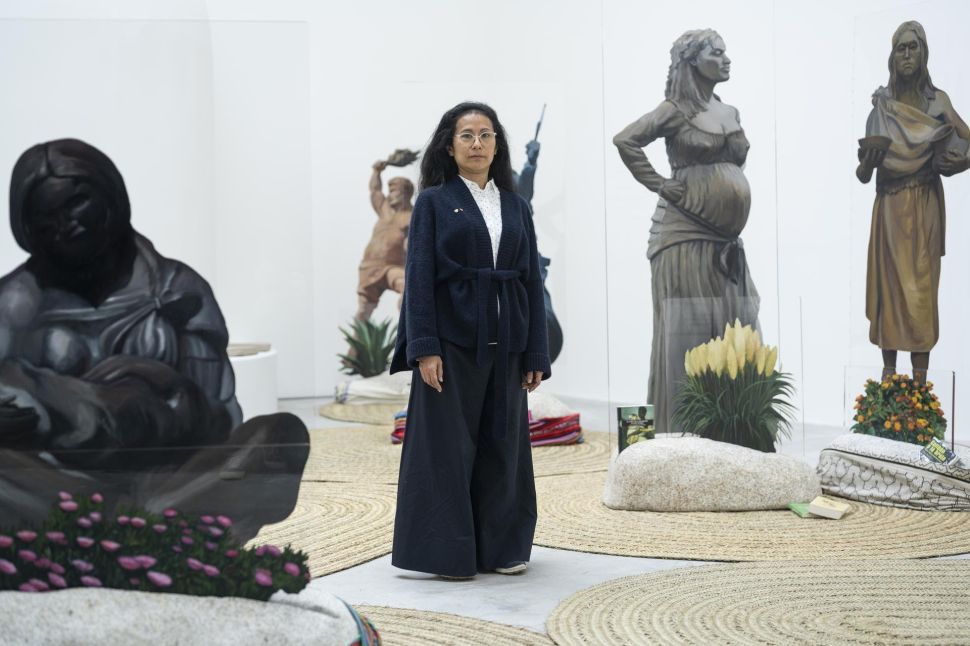
In early March, Gamarra Heshiki opened “Réplica,” her first retrospective, at the Museu de Arte de São Paulo. The show revisits images from the Western canon to question the hierarchies and narratives upheld by traditional museums.
Canepa, who was born in Lima, has taken a different approach in Fardo at the Palacio de Cristal in Madrid. The installation fully covers the iron-and-glass structure, which is part of the Reina Sofía Museum and is currently under restoration in El Retiro Park. She wrapped the building in a printed surface inspired by pre-Columbian funerary textiles from the Paracas culture, in which bodies were covered in multiple layers of cloth.
“The work enters into dialogue with a knowledge system that has often been displaced or misunderstood within Western institutions,” Canepa told Observer.
She said showing the project at the Palacio de Cristal allows it to exist within the very structures that once displayed and classified other cultures. She also said international attention often moves in cycles across the Global South and that Peru is likely part of that dynamic.
At the Wexner Center for the Arts in Ohio, Garrido-Lecca’s exhibition “Seedings” brings together installations with seeds, plants and fibers to contrast ancestral agricultural knowledge with contemporary systems of extraction and production.
“I don’t see my work as representing Andean or Mesoamerican knowledge,” Garrido-Lecca told Observer. “Instead, I place this knowledge and its symbolism in tension with modern infrastructures and colonial systems, to create a space for reflection.”
She said the main shift has been in how the work is received globally, but warned against treating Andean cosmology as an aesthetic resource rather than a worldview shaped by material histories of extraction, labor and resistance.
“I would hesitate to call it a structural change,” she said. “When that change does happen, I hope it will not be measured by the number of Peruvian artists exhibiting abroad, but by a real redistribution of value, authorship and knowledge.”
Read more from Observer.