
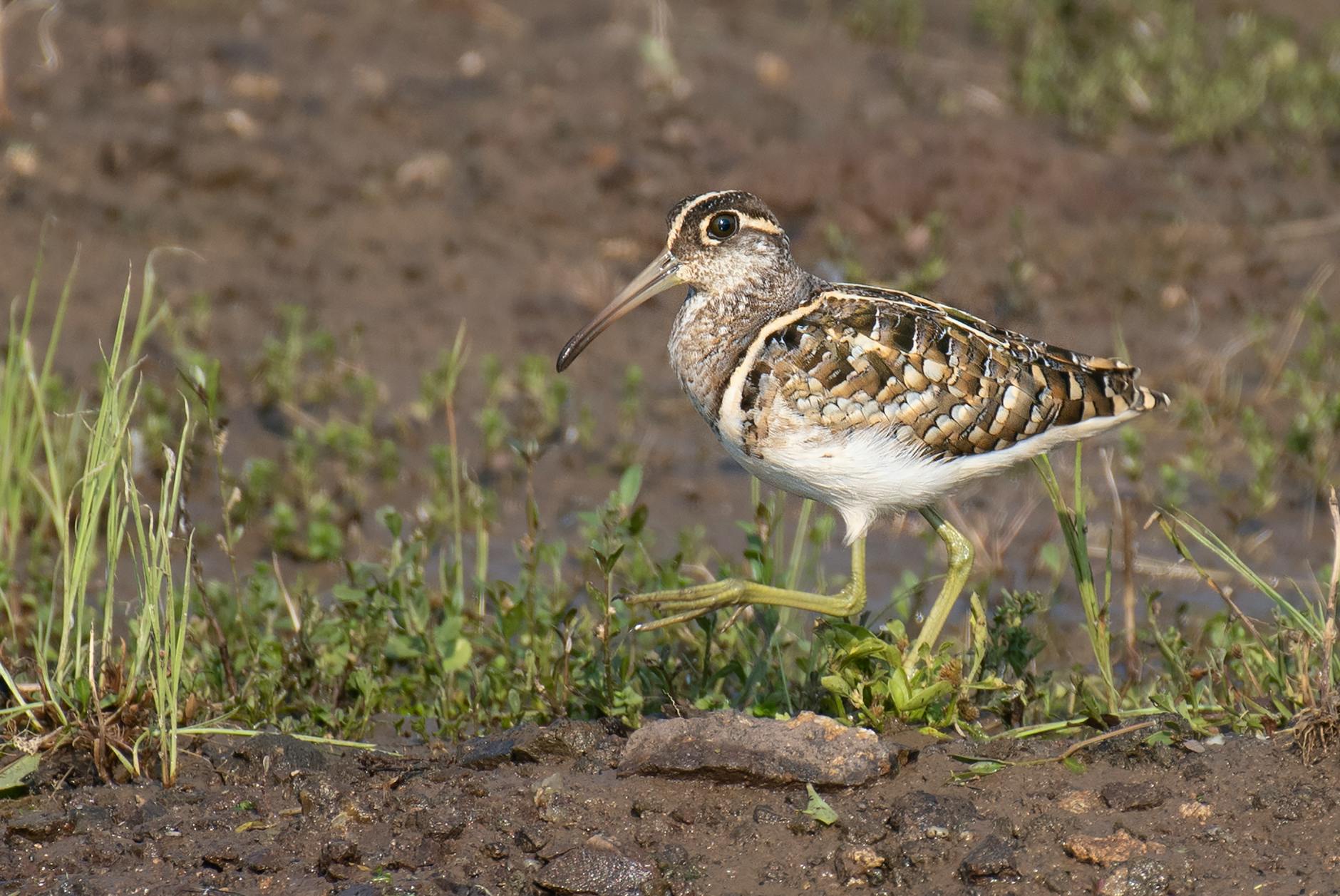
American woodcocks turned up in Bryant Park in late March, and plenty of New Yorkers have been showing up to see them.
The grapefruit-sized birds, known for their bobbing walk and kazoo-like calls, have drawn daily crowds in the Midtown Manhattan park. Spectators have been trying to catch a glimpse of the birds as they poke their long bills into the ground for earthworms.
“It’s a very charismatic bird. I mean, it’s goofy-looking. It’s got eyes that are always looking at you no matter where you are. It does this nice little dance when it’s nervous,” said Bill Rankin, a Yale University professor who stopped by the park. “Having two of them together is a kind of nice little romantic story of spring.”
American woodcocks stop at Bryant Park every year as they migrate north in early spring. They have a round body, enormous eyes and a long, thin bill. Some people also call them “timberdoodles” or “bogsuckers.”
This year, they have attracted more fans than usual, partly because videos and photos have spread widely on social media. Crowds of bird fans carrying smartphones and cameras have been gathering every day for a look at the birds’ walk, while mostly keeping a respectful distance.
The walk that made the woodcock a viral hit online involves the bird shimmying and bobbing its head. Some woodcock fans describe it as a mating dance, but scientists who study the birds have other theories. They have described it as possibly an antipredator display or a foraging technique.
“What you’re seeing in Bryant Park when it’s sitting around when these crowds are looking at it, is mostly a little bit of foraging behavior,” said Andrew Farnsworth, a scientist with the Cornell Lab of Ornithology. “A little of roosting and stretching, and then some of this sort of, you know, kind of sensory stuff looking around, and a little bit of deception, too.”
The woodcock’s courtship display is another attraction. The male makes a buzzing call that birdwatchers describe as a “meep” or “peent” before flying high and erratically against the night sky to try to win the affection of the female.
The birds in Manhattan will likely continue migrating north in the middle of April.
Their popularity has also created a chance to educate the public about threats including collisions with building glass, said Ryan F. Mandelbaum, a New York City naturalist and author of the book “Wild NYC: Experience the Amazing Nature in and around New York City.” American woodcocks are not endangered, but their population has declined in recent decades.
“I was also heartened to see that people are engaging with the conservation threats around light pollution and glass that woodcocks face,” Mandelbaum said. “I love the community and shared joy that’s been emerging from people seeing the bird.”
Read more from ABC News.