
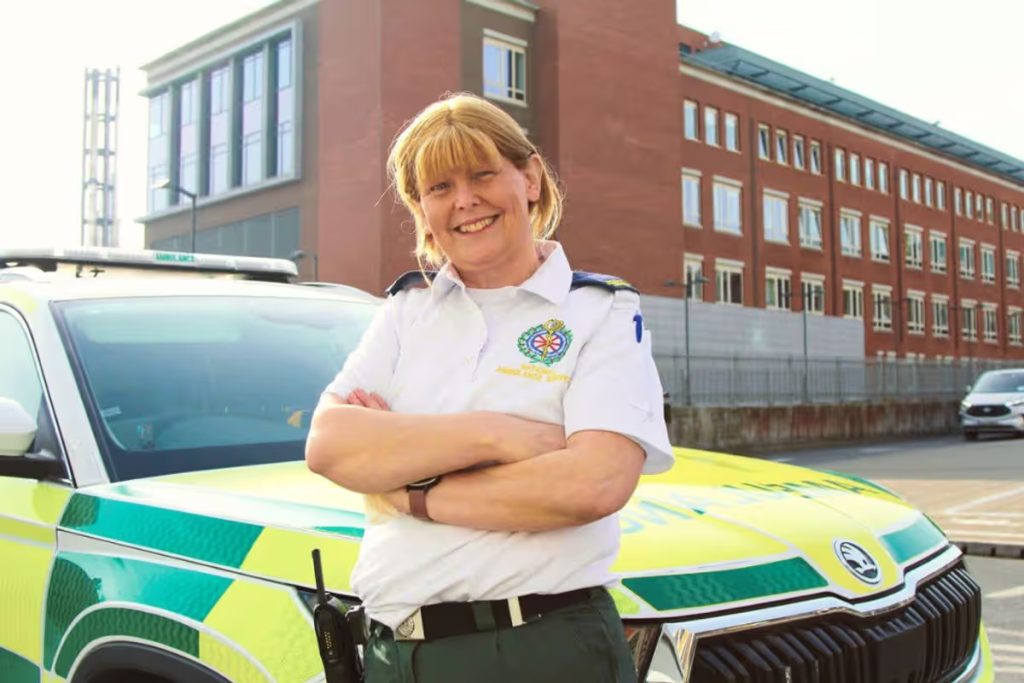
For Deirdre Tuite, the decision to change careers came late, but the ambition had been there for years.
The Dublin mother of four is now a newly qualified paramedic after retraining in her late 40s, following a 20-year career as an educator. She said family life had made the move hard earlier on.
“I always wanted to become a paramedic and always talked about it, but my husband worked shifts in ESB, so it was never the right time. You couldn’t have two people working shifts with four kids, it wouldn’t have worked,” she said.
As her children got older and her husband Martin moved into an ESB office role, Tuite decided to act. She said caring for her mother, who had chronic obstructive pulmonary disease, also shaped that decision.
“In 2022, we were told she was palliative. I knew I’d need something to focus on when she was gone.”
Tuite said paramedics had been called to help her mother on several occasions, and she was struck by how quickly they could help. A rescue involving her son Conor also stayed with her.
In 2020, Tuite and her family were on a hike in Wicklow when Conor, then seven, slipped and badly injured his leg. The coast guard airlifted Tuite and Conor off the mountain, and they were flown to Dublin Airport, where a National Ambulance Service ambulance was waiting before they were taken to Temple Street Children’s Hospital for surgery.
“Seeing how good they were with Conor, and how the whole system worked together, was just amazing. I knew it was for me.”
In March 2022, the National Ambulance Service advertised for student paramedics. Tuite got a place on the course and left her job at QQI, where she had worked for two decades.
“I worked for QQI, the national awarding body. I left a very nice, permanent and pensionable public sector job to take a leap of faith.”
She first took a career break, with support from QQI, and started training in December 2022. She said the return to study was difficult at first.
“I hadn’t studied in 20 years, suddenly we were talking about academic writing, literature reviews and referencing. But I loved the medical side of things.”
Her degree took three years and included exams, assignments, continuous development training, and placements on ambulances and in hospitals. She graduated last month with a 2.1 degree and now works full time on the ambulance, along with overtime.
Tuite said her shifts vary, and she gets her roster four weeks in advance.
“I am non-rostered, so I get my rosters four weeks in advance. In a month, you’d work 13 12-hour shifts. They can be a combination of a week of nights, a week of days, or a mix of both. Usually it’s three shifts for three weeks then four shifts on the last week. But you can put in for leave and rest days.”
She said no two days are the same, but each shift starts with checking the ambulance to make sure it is fully stocked. Tuite said she especially values caring for older patients.
“We do a lot of nursing home calls. I am very particular to make sure the patient is looked after and their advance care directive is followed. This is a form that loved ones fill out that will inform us if the patient should be transferred to hospital, whether CPR should be used.
“Some people’s care directives say they should not be transferred and they should be made comfortable in the nursing home.
“I always advocate for my patients. I have so much time for older people. Having lost my mam, I know that her wishes were respected, and I want the same for my patients.”
She said some cases are hard, especially when a patient dies, but she tries not to carry that home with her.
“It’s sad, but it’s not my sadness. It’s heartbreaking for the patient and their family. But I believe we are only given a certain amount of grief in our life that we can actually manage, I don’t take home that sadness. If I lost a patient, I might light a candle for them on my mam’s little table.”
One call still stays with her.
“You can never leave that behind. That was the first and only one I’ve had so far, she will always have a little place in my heart.”
Tuite said it can also be difficult when patients refuse treatment.
“If they have the capacity to make that decision, we can’t make anyone go to hospital. Only the guards can restrain patients, we can’t touch them. But I could talk anyone into going to hospital,” she said.
Her daughter Rebecca is now in her second year of paramedic training after switching from biomedical science. Tuite said they have worked a few shifts together and that patients enjoy seeing them side by side.
She also recalled attending a call involving a young man who had fallen off the side of a cliff while cycling. Tuite said she stabilised him and called in the coast guard to rescue him from the mountain, echoing the rescue that once helped her own son.
“I always have a laugh with my patients. I think it’s the best job in the world. We are so privileged and lucky to do it. When we knock on the door, people are so grateful to see us. Not every job is like that.”
Read more from Goodable.